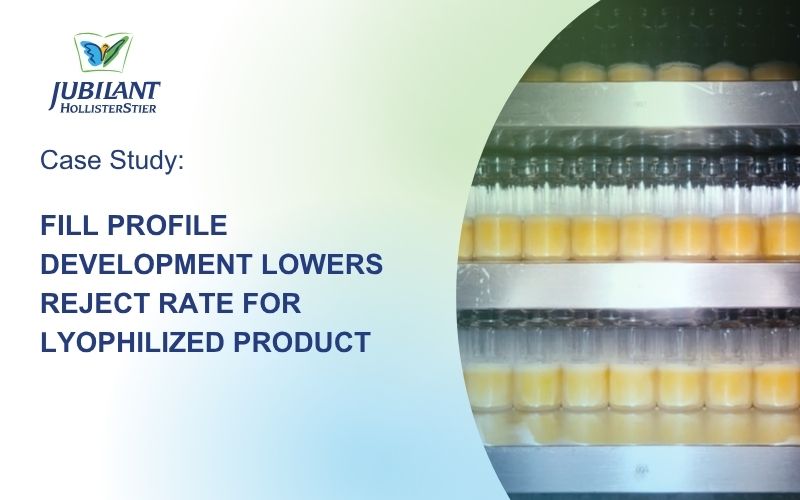
Fill Profile Development Lowers Reject Rate for Lyophilized Product

See how smarter filling saved a biologic from a double-digit reject rate. 

A small amount of liquid left on the vial wall can mean a costly reject, especially when a high-value API is on the line. For one client’s high-value biologic, that meant reject rates reaching as high as 13% per batch.

In this case study, you’ll learn how Jubilant HollisterStier’s technical experts:

  • Identified the root cause of residue-driven rejects during tech transfer
  • Reduced the defect rate from product residue to 1% or less
  • Improved batch yield and conserved a high-value API  
Lyophilizer

Related Posts

Lyo Cycle Development Ensures Success for Oncology Drug Scale-Up

Lyo Cycle Development Ensures Success for Oncology Drug Scale-Up

Find out how engineering-led cycle development bridged the gap from benchtop to validated-scale up. What works on a benchtop doesn't always survive the jump to a large-scale lyophilizer. See how JHS engineers identified the root cause of a failed PPQ validation run...

Increasing Batch Size and Reducing Cycle Times for a Biologic

Increasing Batch Size and Reducing Cycle Times for a Biologic

Challenge An existing partner wanted to work with JHS toinvestigate new ways to reduce the cycle time of abiologic product in order to serve more patients. Approach JHS has worked with this top 20 global pharmapartner for 15+ years on this drug product andsearched for...